Posts

Why Holden Doesn't Actually Hate Movies
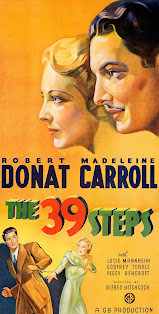
Image
    Throughout The Catcher in the Rye Holden constantly mentions that he hates the movies. So much so that it's one of the first things we learn about him when on the second page he says "If there's one thing I hate, it's the movies. Don't even mention them to me" which was also in reference to DB being in Hollywood. However, they seem to keep coming up in the story, and he even has some memories of seeing movies with Phoebe as well as DB multiple times. He mentions having seen her favorite, The 39 Steps multiple times as well and here he doesn't even seem to dislike it (Salinger 76). There's also the trip he goes on at the beginning of the book with Ackley and Brossard to see a movie though they never end up actually going to it (Salinger 42). And then there's the fact that he seems to  talk about movies in a way that implies that he's seen enough to know they're all bad. While that might have been possible in New York in the 1940s, but i...

All posts from here on will be for Coming of Age Novel

The Hero's Journey in As I Lay Dying

Image
    It is definitely not easy, but I do think it's possible to see some elements of the hero's journey in William Faulkner's As I Lay Dying . However, the hero isn't just one individual, it's the entire Bundren family which is essentially acting as one unit. It is also possible to see some smaller hero's journeys for individual characters like Darl and Cash, but here I'm just going to focus on the Bundren family, since I think it's easiest to see a hero's journey that way. However, there are still many steps that aren't really here. There's not much of a supernatural aid, meeting with the goddess, temptation, atonement with the father, and it feels like a lot of the parts of the return phase are also missing. However, there is a significant change in the family over the course of the journey, mainly Anse deciding to get a new wife days after burying Addie, and Darl going to a mental hospital. They do seem to have gone through some kind of col...

Criticizing Murdock

     Maureen Murdock's model of the heroine's journey is somewhat like Victoria Lynn Schmidt's model and the Hero's Journey, but is generally more restrictive and harder to apply.  It would still be much easier to just have one definitive monomyth that was more broadly applicable and didn't discriminate based on gender. And that emphasis on gender and to a lesser extent on spirituality is the main problem with Murdock's model. It's difficult to apply when it forces stories to revolve around or heavily feature these concepts and as a monomyth it definitely shouldn't, though much like Victoria Lynn Schmidt's model it may not be entirely intended to be a monomyth. However, if it was broader and more about identity that just gender it would be more easily applicable, like in the case of Quicksand where it uses some ideas from Murdock's model but in the context of race.      While it's not as useful as Victoria Lynn Schmidt's model, they two d...

Criticizing Victoria Lynn Schmidt's Model of the Heroine's Journey

    The first main problem with Victoria Lynn Schmidt's Heroine's journey is that while it may be better than the Hero's journey, it still has some pretty stringent elements. This is mainly due to the emphasis on the heroine undergoing a spiritual change, as there are many stories that fit the model decently but don't have much of a spiritual change and something like The Hunger Games come to mind. This as well as the emphasis on a betrayal at the beginning make it much harder to apply broadly. However, it is possible that it wasn't entirely meant to be a monomyth in the same way as the hero's journey and seems to be designed to be a bit more specific. However, the "Descent", "Eye of The Storm", and "Death" Stages do work in a more broad variety of stories so it was definitely meant to loosely fit most stories that at least feature a heroine. It is also less restrictive than Maureen Murdock's model which focuses too much on gen...

The Hero's Journey in Star Wars

     The way Luke is depicted crossing the threshold in George Lucas's Star Wars, a New Hope  is a bit unusual since it's not so much of a willing decision as it is Luke being forced across the threshold out of necessity. This is much different from how the belly of the whale is represented, which is more in line with Campbell's description of it . However, the way Campbell describes the crossing of the threshold is as the transition from the known world into the unknown world which in a way is represented by Luke's parents and Obi Wan respectively. Obi Wan is pretty much the only reason Luke didn't have the same fate as his parents since he was distracting Luke, which essentially left his only choice being to go with Obi Wan. It was also a bit of a necessity since otherwise Luke would never have gone with him. Really the only decision Luke made was to buy R2-D2 and C-3PO even though he didn't really know what that would lead to. And that also wasn't entirel...